
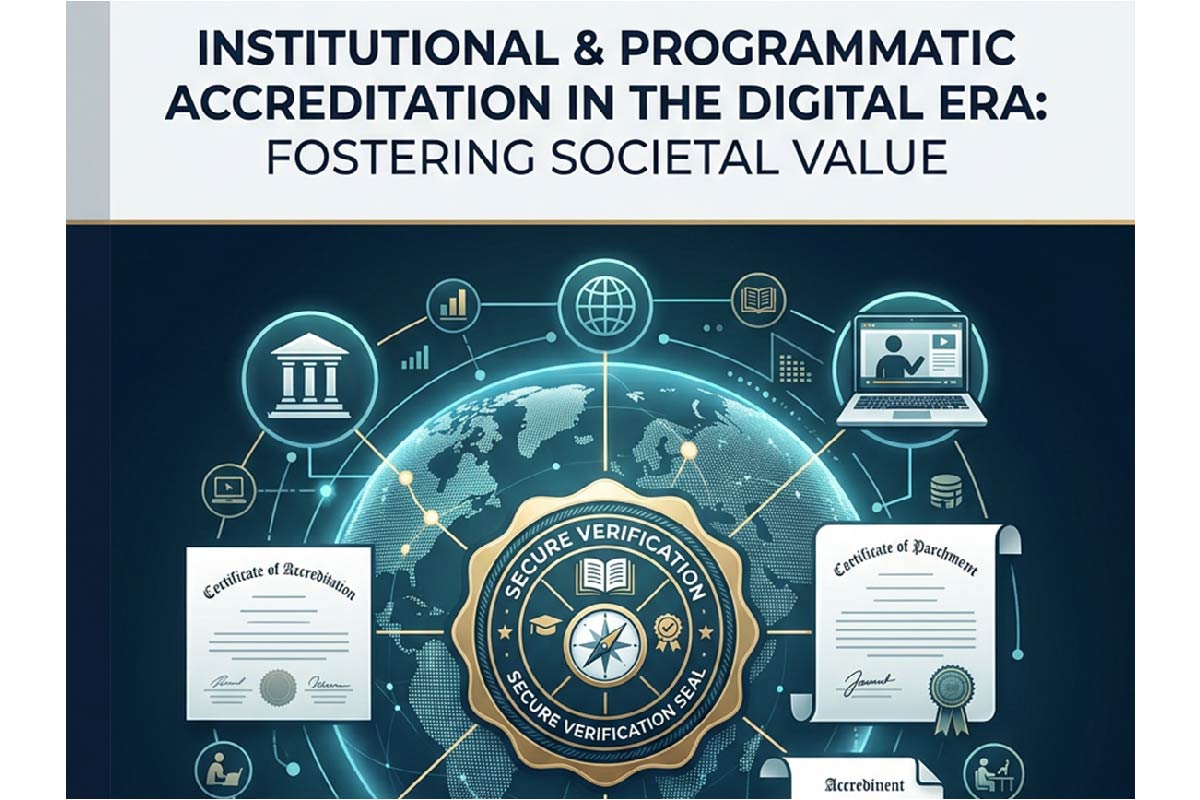
Institutional Accreditation, Programmatic Accreditation, and the Societal Value of Distance Learning Institutions: A Critical Synthesis
Abstract
The expansion of distance learning has transformed higher education’s delivery, reach, and social mandate. As online and hybrid provision has matured, accreditation systems have become central to institutional legitimacy, quality assurance, and public trust. This article examines the relationship between institutional accreditation and programmatic accreditation in distance learning institutions, arguing that each serves distinct yet complementary functions within a broader ecosystem of accountability. Institutional accreditation evaluates the organization’s governance, mission, financial integrity, and quality assurance capacity, while programmatic accreditation assesses the substantive quality and professional relevance of specific academic offerings. In distance learning contexts, these distinctions are particularly consequential because digital delivery introduces novel challenges related to pedagogical design, learner support, technology infrastructure, verification of student identity, academic integrity, and equitable access. Beyond regulatory compliance, accreditation carries wider societal value: it protects learners from low-quality provision, strengthens workforce readiness, supports social mobility, and promotes trust in transnational education. The article further argues that for distance learning institutions, accreditation should be conceived not merely as an audit mechanism but as a public-interest framework that connects educational quality to social outcomes. The discussion concludes with implications for policy, institutional strategy, and future accreditation models suited to digitally mediated higher education.
Keywords: institutional accreditation, programmatic accreditation, distance learning, quality assurance, online higher education, societal value, public trust
Introduction
Distance learning institutions occupy an increasingly important position in higher education systems worldwide. The growth of digital platforms, asynchronous delivery, and transnational enrolment has made education more flexible and more accessible, but it has also complicated traditional mechanisms of quality assurance. In a physical campus model, quality is often inferred from visible infrastructure, face-to-face academic oversight, and established administrative routines. In a distance learning model, however, quality must be inferred through mediated interactions, digital systems, learning analytics, remote assessment, and institutional design. This shift has made accreditation more important, not less.
Accreditation in higher education is typically divided into institutional and programmatic forms. Institutional accreditation evaluates whether an institution as a whole is capable of delivering education consistent with its stated mission and with accepted standards of governance, resources, and academic quality. Programmatic accreditation, by contrast, examines whether a particular program or discipline meets external standards of professional and academic excellence. While both forms seek to assure quality, they answer different questions. Institutional accreditation asks, “Is this institution fit to operate as an educational body?” Programmatic accreditation asks, “Is this specific academic offering sufficiently rigorous, relevant, and current?”
For distance learning institutions, the distinction is especially significant. A distance learning institution may have strong governance and administrative controls but still offer weak programs. Conversely, it may host an excellent program in one discipline while lacking coherence across the organization. The interplay of these two forms of accreditation therefore becomes a crucial part of understanding quality in digital education. Yet accreditation should not be understood merely as bureaucratic oversight. In the distance learning sector, it has direct societal implications. It shapes learner trust, labor market recognition, inclusion, cross-border mobility, and the broader legitimacy of educational opportunity. The central claim of this article is that accreditation, when properly designed and interpreted, is a public good.
Institutional Accreditation: Purpose and Scope
Institutional accreditation is the foundational layer of external quality assurance. It evaluates the institution’s capacity to deliver education in a sustainable, ethical, and mission-consistent way. In most quality assurance systems, institutional accreditation addresses governance, leadership, strategic planning, financial viability, academic policies, student support, faculty qualifications, resource adequacy, and internal quality assurance processes. It asks whether the institution has the structures and culture needed to maintain standards over time.
In distance learning environments, institutional accreditation takes on added complexity. First, the institution must demonstrate that its digital infrastructure is reliable, secure, and pedagogically fit for purpose. Second, it must show that its student support systems function effectively at a distance, including admissions, advising, tutoring, technical support, and grievance processes. Third, it must establish robust mechanisms for assessment security, data protection, accessibility, and continuity of delivery. Fourth, it must show that quality assurance is not merely symbolic but embedded in institutional practice, with evidence of regular review, improvement, and responsiveness to learner needs.
Institutional accreditation in distance learning institutions therefore becomes more than a badge of legitimacy. It is a signal that the organization has institutional maturity. Such maturity is especially important in online education because the learner often interacts with the institution through interfaces rather than physical presence. Trust is mediated through websites, learning management systems, digital certificates, online admissions, and remote communication. Institutional accreditation assures the public that these systems are not arbitrary or opportunistic but subject to external scrutiny.
From a policy perspective, institutional accreditation also helps prevent market dysfunction. The distance learning sector is vulnerable to low-quality providers that may prioritize enrolment growth over educational substance. Institutional accreditation creates a barrier against such exploitation by requiring demonstrable capacity, transparency, and accountability. It protects students from investing time and money in institutions that lack sustainability or legitimacy.
Programmatic Accreditation: Subject-Specific Quality and Relevance
Programmatic accreditation complements institutional accreditation by focusing on the quality of individual programs. Whereas institutional accreditation evaluates the institution as a whole, programmatic accreditation evaluates a specific field of study, such as business, engineering, computing, teacher education, health sciences, or other professional disciplines. It examines whether the curriculum is current, whether learning outcomes are appropriate, whether faculty expertise matches the field, and whether the program prepares learners for further study or employment.
In distance learning institutions, programmatic accreditation is particularly important because the quality of a program may not be visible from the institution’s general reputation. A distance institution may have strong administrative systems but offer underdeveloped programs that lack discipline-specific coherence. Programmatic accreditation therefore serves as a discipline-level quality filter. It identifies whether the program’s content, methods, assessment, and outcomes are aligned with current academic and professional expectations.
This is especially relevant in fields that are rapidly evolving. In computing, data science, cybersecurity, engineering, and business, for example, curriculum relevance depends on continuous engagement with labor market trends, technological developments, and professional standards. Distance learning programs must therefore demonstrate a mechanism for ongoing renewal. They must show that asynchronous design does not mean curricular stagnation. They must also show that practical competencies, applied learning, and authentic assessment can be delivered effectively at a distance.
Programmatic accreditation may also carry employer-facing value. Employers often use accredited status as a shorthand for programme quality and graduate readiness. This is especially important in distance learning, where the modality can provoke skepticism among employers unfamiliar with online provision. A programmatic seal helps overcome this skepticism by indicating that the program has been benchmarked against external standards and has met expectations specific to the discipline.
The distinction between institutional and programmatic accreditation is not merely administrative. It reflects two levels of educational accountability. The institution is responsible for the conditions under which learning occurs; the program is responsible for the substance of what is taught and learned. In a well-designed system, both must work together.
The Special Case of Distance Learning Institutions
Distance learning institutions challenge conventional assumptions about higher education quality. They often operate across borders, across time zones, and across diverse learner populations. Their teaching and support systems are mediated through technology, and their student body is frequently non-traditional: working adults, caregivers, international students, rural learners, and others seeking flexible access to education. This makes accreditation both more necessary and more difficult.
One challenge is that quality in distance learning is often distributed across systems rather than concentrated in a campus environment. Curriculum quality depends on instructional design, digital pedagogy, faculty engagement, content management, and learning analytics. Student support depends on chat systems, virtual office hours, online advising, and automated services. Assessment integrity depends on proctoring systems, question design, identity verification, and policy enforcement. All of these components must be evaluated by accreditation bodies.
Another challenge is equity. Distance learning has the potential to widen access, but not all learners have equal access to devices, broadband connectivity, study space, or digital literacy. Accreditation systems concerned with public value must therefore examine whether institutions have designed their programs to support diverse learners. Accessibility is not a peripheral issue; it is central to quality. An accredited distance institution should demonstrate that it has considered universal design, captioning, device compatibility, flexible scheduling, and support for learners with disabilities.
A third challenge concerns transnational recognition. Distance learning institutions may recruit internationally, deliver asynchronously across jurisdictions, and issue qualifications that circulate across different regulatory environments. This creates both opportunity and risk. Accreditation helps provide a common language of quality across borders. It signals that the institution or program has been judged against standards that are not purely local or commercial.
Societal Value of Accreditation
Accreditation is often discussed as a technical mechanism of quality assurance, but its significance extends well beyond the education sector. It has social, economic, and civic implications. The societal value of accreditation can be understood across five dimensions: protection, trust, mobility, equity, and public accountability.
First, accreditation protects learners. Students are among the most vulnerable participants in educational markets because they invest time, money, and hope in a qualification whose value may not be immediately visible. Accreditation reduces informational asymmetry by allowing learners to distinguish between credible and weak provision. This is especially important in distance learning, where marketing claims can outpace educational substance.
Second, accreditation builds trust. Society depends on credentials as signals of competence, but those signals only work when the public believes they are meaningful. Accredited status supports confidence among employers, professional bodies, and other educational institutions. It tells the public that the qualification has been reviewed against recognized standards. In distance learning, where physical cues of quality are less visible, trust becomes even more dependent on accreditation.
Third, accreditation supports mobility. Recognized institutions and programs make it easier for graduates to transfer into postgraduate study, professional certification, or employment across regions and countries. This is crucial in a global labor market where digital education has become increasingly transnational. Accreditation can therefore enhance the portability of learning and improve opportunities for social and geographic mobility.
Fourth, accreditation promotes equity. When distance learning institutions are held to meaningful standards, they can serve learners who may otherwise be excluded from traditional higher education. Accredited online programs can support access for adults, caregivers, workers, rural populations, and international learners. In this sense, accreditation helps turn access into credible opportunity rather than low-cost credential inflation.
Fifth, accreditation strengthens public accountability. Higher education receives societal support through public funding, regulatory recognition, tax policy, and social legitimacy. Accreditation ensures that institutions serving the public interest do so transparently and responsibly. It helps align educational expansion with quality, rather than allowing market growth to become detached from social responsibility.
Quality, Digital Pedagogy, and the Future of Standards
Traditional accreditation standards were developed in an era when education was predominantly face-to-face and campus-based. Although many of those standards remain relevant, they require reinterpretation in the digital age. Quality in distance learning is not identical to quality in classroom-based education. The former depends less on physical presence and more on the integration of technology, pedagogy, and student support into a coherent learning ecosystem.
Future accreditation frameworks should therefore pay greater attention to digital pedagogy. They should ask whether faculty are trained in online instructional design, whether learning materials are accessible, whether synchronous and asynchronous interactions are well balanced, and whether assessment practices are appropriate to the modality. They should also examine whether institutions use data ethically and effectively to improve learning. Learning analytics, student engagement metrics, and digital feedback systems can be valuable, but only if governed transparently.
Programmatic accreditation may be especially important in this context because discipline-specific standards can incorporate the practical realities of remote delivery. For example, in teacher education, distance learning programs must address practicum requirements and field-based competencies. In health-related fields, they must ensure that practical skill acquisition and ethical safeguards are not compromised by remote formats. In business and management, they must show that the curriculum remains responsive to global workplace shifts and entrepreneurial realities. In computing and engineering, they must demonstrate robust laboratories, simulations, or equivalent applied learning environments.
A future-oriented accreditation system should therefore be flexible enough to assess modality-specific quality without reducing everything to generic compliance. It should be rigorous but not rigid, standardized but not uniform. Its aim should be to protect educational integrity while allowing innovation to flourish.
Accreditation as a Public-Interest Framework
The strongest argument for accreditation in distance learning may be that it serves the public interest. Education is not only a private good purchased by individuals for personal advancement. It is also a public good that contributes to workforce development, democratic participation, civic culture, innovation, and social cohesion. Accreditation helps ensure that this public good is genuinely realized.
When a distance learning institution is institutionally accredited, the public can trust that its governance and systems have been externally reviewed. When a program is programmatically accredited, the public can trust that the specific field of study meets discipline-relevant benchmarks. Together, these forms of accreditation create a layered accountability structure that supports the broader legitimacy of higher education.
This is particularly important in countries and regions where regulation may be fragmented or where cross-border providers operate in complex legal environments. Without meaningful accreditation, the distance learning sector can become vulnerable to diploma mills, predatory marketing, and low-quality credential inflation. Accreditation acts as a civic safeguard. It protects the social meaning of educational achievement.
At the same time, accreditation should not become purely punitive or exclusionary. Its deeper purpose is developmental. By clarifying standards, identifying gaps, and encouraging improvement, accreditation helps institutions strengthen their missions. This is especially beneficial for distance learning providers serving marginalized or under-resourced populations. Rather than serving only as a gatekeeper, accreditation can function as a developmental partnership that raises quality across the sector.
Policy Implications
Several policy implications follow from this analysis.
First, regulators and quality assurance bodies should distinguish clearly between institutional and programmatic accreditation, especially in digital education. The two should not be conflated. Each answers different questions and serves different public purposes.
Second, accreditation standards should explicitly address online and distance delivery. This includes digital infrastructure, cybersecurity, accessibility, online pedagogy, assessment integrity, and student support. Standards developed solely for campus education are insufficient.
Third, programmatic accreditation should be expanded in fields where professional relevance changes rapidly. Distance institutions need standards that are responsive to labor market evolution, emerging technologies, and new modes of applied learning.
Fourth, accreditation bodies should treat learner equity as a quality issue. Access, inclusion, and support are not separate from quality; they are part of it.
Fifth, transparency should be strengthened. Accreditation decisions, standards, timelines, and renewal expectations should be easy for students and employers to understand. Clear public communication enhances trust and reduces confusion.
Conclusion
Institutional accreditation and programmatic accreditation are distinct but mutually reinforcing mechanisms of quality assurance. In distance learning institutions, their importance is magnified by the mediated, transnational, and technologically dependent nature of provision. Institutional accreditation assures the public that the organization is stable, ethical, and capable; programmatic accreditation assures the public that specific academic offerings are relevant, rigorous, and professionally meaningful. Together, they create a quality architecture that supports educational legitimacy and social trust.
The societal value of accreditation lies in its capacity to protect learners, support mobility, improve equity, and maintain the integrity of educational credentials. In the distance learning sector, where access and scale can sometimes outpace quality, accreditation becomes an essential public-interest mechanism. It is not merely a technical audit but a social compact between providers, learners, employers, and society.
As digital education continues to evolve, accreditation frameworks must evolve with it. They must become more attentive to pedagogy, technology, and inclusion while remaining grounded in core principles of rigor, transparency, and accountability. If they do, accreditation will continue to serve not only as a marker of institutional quality but also as a contributor to social wellbeing.